How can enterprises embrace AI transformation? ‘5A Framework’ unveiled_我的网站
A |
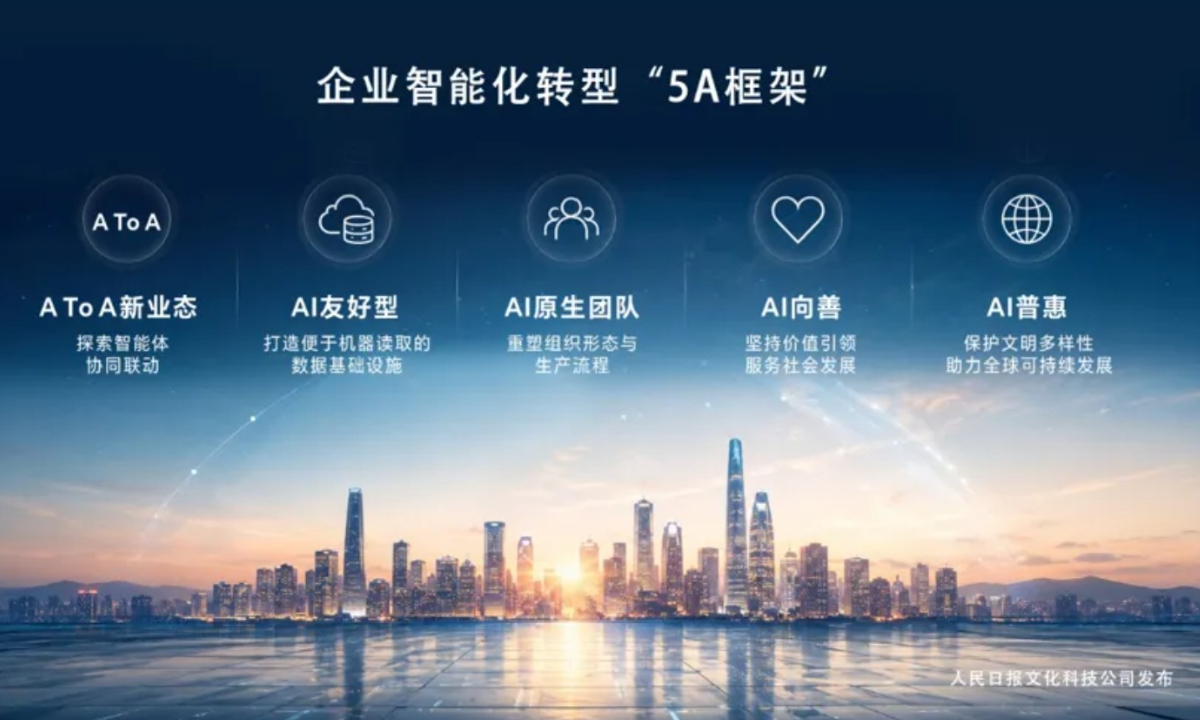
An illustration of the “5A Framework” for enterprise intelligent transformation unveiled at the 2026 Digital Intelligent Economy Forum in Langfang, North China’s Hebei Province, on August 12, 2026. Photo: people.cn
The 2026 Digital Intelligent Economy Forum was held in Langfang, North China’s Hebei Province, on Wednesday. At the forum, organizer People's Daily Cultural Technology Corporation unveiled a “5A Framework” for enterprise intelligent transformation, aimed at helping businesses comprehensively innovate their business models, organizational structures and service systems in the artificial intelligence (AI) era. A To A: Exploring new models for agent collaboration AI is pushing the internet into a new stage characterized by the widespread participation of AI agents. In the future, China could develop an ecosystem comprising tens of billions of agent applications, while the global “digital population” could reach hundreds of billions. Following To B (business-oriented) and To C (consumer-oriented) models, enterprises and institutions should actively explore the emerging To A (agent-oriented) model. To enable better interaction and coordination among agents, unified data, technology, interface and service standards need to be established, while new business systems and service models should be cultivated. AI-friendly: Building machine-readable data infrastructure Today’s internet user interfaces are primarily designed for human browsing. The first step, therefore, should be to build an “AI-friendly” data system that is better suited to being read, understood and accessed by AI. By structuring content resources and turning them into organized knowledge, while strengthening ontology systems and knowledge graphs, such a system can improve AI’s ability to understand and apply information. On this basis, integrated hardware and software infrastructure combining computing architecture with data systems can be developed for AI applications. AI-native teams: Reshaping organizations and workflows AI is profoundly reshaping organizational structures and ways of working. AI-native teams should redefine job responsibilities, organizational structures and business processes around the A-To-A model and AI-friendly services, enabling “everyone to have multiple AI agents.” Professional capabilities and business experience can be encapsulated into “digital employees,” promoting autonomous learning by agents, multi-agent collaboration and the evolution of collective intelligence, thereby multiplying per-capita productivity. AI for good: Putting values first, serving social development AI also requires values-based guidance. Guided by the principle of “being people-centered and using AI for good,” efforts should follow the approach of “governing AI with AI and guiding intelligence with wisdom,” ensuring that AI always serves social development, the public interest and people’s needs. The “Mainstream Values Corpus,” whose development was launched by the People’s Daily in May 2023, has already begun to take shape and has been validated through numerous large-model applications. Inclusive AI: Protecting cultural diversity, advancing global sustainable development AI should not become merely “a game for rich countries and rich people,” but should benefit all countries. Efforts should be made to actively participate in global initiatives for inclusive AI, bridge the digital and intelligent divide, and enable more organizations and individuals to share the benefits of development on an equal footing, so that AI can truly become a powerful positive force for improving the well-being of all humanity and advancing human civilization. This was translated and compiled by the Global Times, based on an article originally published on people.cn on August 12, 2026.
B | 这几年山上的上百亩果树也陆续结果,村民看到了回头钱儿。“山上风景好,空气也好,只是没有电,一到天黑,跟山下村子一比,简直是另一个世界。赶上天旱浇地、浇树,那更不用想了!”在西山居住的村民刘秀凡说。“往西山办电,可真不容易。”了解到西山村民的用电困难,虹螺岘供电所所长杨健向南票区供电公司领导作了汇报。该公司相关部门和供电所工作人员一同到西山进行现场勘察,发现西山离后潘庄子村变压器距离太远,从变压器接电根本不可能。此外,山上村民居住比较分散,果园土地面积较大,把电接到果园里距离太长,需要从山下把20多棵高压电线杆一直立到1公里外的山顶,还要把30多棵低压电线杆立到约1.5公里的每户果园中,工程量太大。特别是要把100千伏安变压器安装到山顶的电线杆上,把高低压线路架到山上,工程难度非常大。
面对西山8户村民期盼用上电的强烈渴望,感受村民们对靠天吃饭的担忧和依靠电力发展种植业发家致富的美好向往,南票区供电公司迎难而上,很快就批准了西山村民办电的申请。
4月初春,杨健带领虹螺岘供电所员工按计划开展施工。
C | 在还没完全解冻的西山山坡上,施工人员顶着五六级大风挖坑立杆。进入六月,气温升到零上27—28摄氏度,大家在杆上架线、安装变压器,一干一身汗,身上的工作服都能拧出水来。“进入6月,老天爷就没下过一场像样的雨。平地的庄稼都旱了,山上的作物再不浇都会枯死。真没想到供电公司会下这么大力气为西山8户村民办电,这真是太及时了,西山上百亩作物和上千棵果树有救了!”村民王延平指着从山下一直架设到山上的线路,面带笑容道出了心中的感慨。
Current article:http://b7n61e.michengyuraochixun.buzz/list_lzd1/78mos9d.html